

Alongside the evening’s other sponsors, Augentic, QBE and Concirrus, Artificial hosted one of several discussions around digital broking and underwriting transformation - this time from the lens of our new Chief of Markets, Elizabeth Wooliston.
Conversations at the event made it clear that the market has moved beyond debating digitisation in principle, with the focus now on execution. A softer cycle approaching and increasing pressure on margins mean that discussion is now around how brokers and carriers can use technology to protect performance and sharpen strategy.
Market association to market infrastructure
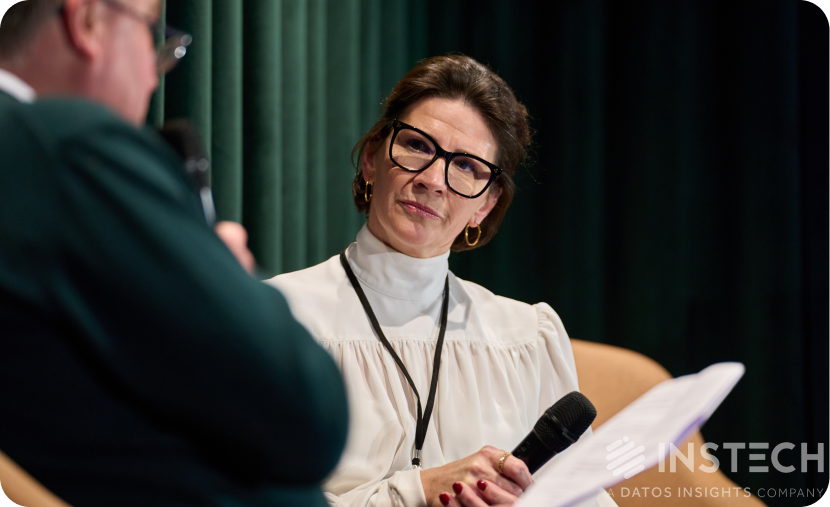
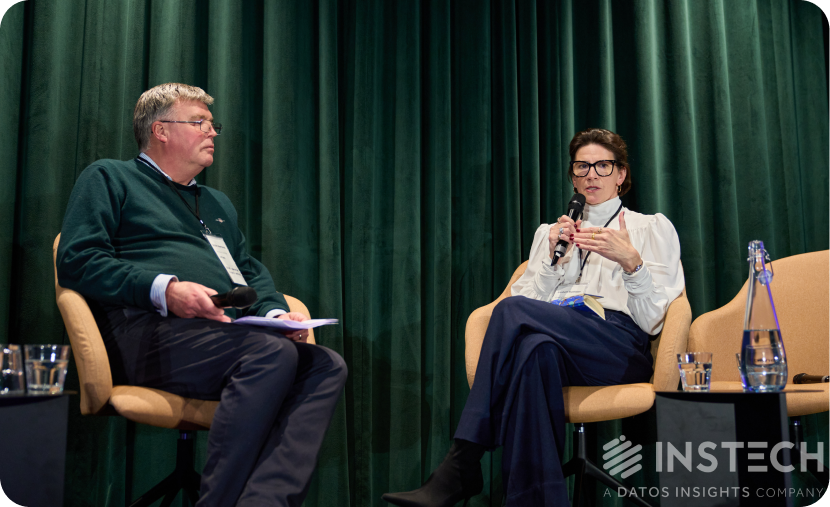
Elizabeth returned to the InsTech stage a year after appearing on a panel representing the Lloyd’s Market Association (LMA). This time, she spoke from a different perspective, reflecting on her move to Artificial and what she has seen since joining the business.
Elizabeth’s move, she explained to host Robin Merttens, came down to action. After working on market-wide initiatives and seeing the slow progress in certain areas of the industry, she wanted to help build the operational systems that would shape how specialty insurance actually functions day to day.
She joined us shortly before we announced our $45 million Series B raise this month, and described how Artificial is a company that combines deep insurance expertise with genuinely configurable technology. We are not offering surface-level digitisation, but are rather building insurance technology that allows brokers and carriers to codify strategy and deploy it at scale.
When asked why Artificial has managed to reach this milestone when so few others have, Elizabeth explained that it has taken hard work, an incredibly knowledgeable team, and years of building credibility in the market - all of which is not easily replicable.
Elizabeth also spoke of her excitement around Artificial’s configurable in-house coding language. Our programming language is insurance-native, which allows for endless configuration far beyond the capabilities of any other standard coding language that is retro-fitted for insurance. The technology can be applied to virtually any model to enhance human decision making: placement, follow and lead, consortia, facilities or even MGAs.
For example, one of our broker clients recently used the technology to codify their open market ‘decision tree’ for risk - something which had taken them 30 years of experience to perfect. There is no other technology capable of codifying such a complex thought process, triaging the risks, enhancing them with external data and then pointing the underwriter at the risk - taking away the noise and admin.
On the opportunity side, she cited Artificial’s ambition to become the default digital infrastructure for specialty insurance. The market is now much more open to digitisation, but much of it still runs on manual processes and fragmented systems, so the scope for improvement remains significant.
What’s next for brokers and carriers
As we head into a soft market and margins become tighter, there is an enormous opportunity for technology to provide brokers and insurers with a way to scale whilst keeping tight reins on operational expenditure.
It’s clear from our conversations with brokers that they have started to digitise and come on board with the opportunities a softening market will bring. As digital, data-first contracts become more common, brokers are beginning to see what structured data makes possible.
They are not simply trying to reduce administration, but instead are redesigning facilities, optimising capacity relationships and increasing GWP without increasing headcount.
For carriers, Elizabeth emphasised the need to be ready for the changes broker facilities are bringing. This means preparing for the full range of broker-led distribution models, including open market flows, onboarding coverholders efficiently, or handling BDX submissions in a structured way.
There is also a huge opportunity for carriers to support portfolio solutions that combine different sources of risk into coherent capital strategies. We see this as a ‘mixing desk’ model where portfolios can easily be adjusted in real-time to model varying scenarios and optimise outcomes.
Perhaps the most important takeaway from Elizabeth’s talk was that carriers should be preparing for increasingly data-led broker strategies. As brokers gain more control over structured data and placement design, carriers will need digital tooling that allows them to respond quickly while maintaining underwriting discipline.
Looking ahead to 2026
When asked what 2026 looks like for Artificial, Elizabeth said the priority is continued investment in product and the team. Whilst we have an extensive tech stack already, it needs to scale robustly for the growth we expect in 2026.
She also noted that the company is scaling its team significantly, and where we were once considered a start up, we are entering a new phase of maturity - so if you’re interested in joining us, visit our careers page.
The discussion made one point clear: digital placement and underwriting are no longer ‘nice to haves’, but are becoming central to how brokers and carriers will compete in the next cycle.
If you would like to explore how Artificial could support your 2026 strategy, get in touch.
